



Newsletter
Join life in the fast lane
Stay connected with the latest from our dealerships, including new model introductions, exclusive events, curated inventory, Ferrari news, and more.
With its 1956 Tour de France win, the 250 GT Berlinetta earned the ‘TdF’ nickname and began a nine-year winning streak.
In modern endurance racing, Ferrari is synonymous with success at the 24 Hours of Le Mans, but 70 years ago, a defining run of victories began at another epic French test of stamina, of which the Le Mans circuit was just one element: the 1956 Tour de France Automobile.
A 6,020-kilometre, six-day test of both car and driver, it combined controlled average speeds over public roads with flat-out stints taking in six circuits, two hill climbs and a single acceleration test.
This was not the first Ferrari win on the multi-disciplinary event – Alfred Barraquet took victory in a 212 Export on the first post-war Tour de France in 1951 – but when Alfonso de Portago won in 1956 driving a 250 GT Berlinetta, he set the stage for a near decade-long run of success that would remain unchallenged in the event’s history. Even now, the 250 GT Berlinetta continues to be informally suffixed ‘Tour de France’.
Derived from the 250 Europa GT as introduced on the Tipo 508 chassis in 1954, the 250 GT Berlinetta debuted in 1956 and formalised the Ferrari gran turismo template that the 12Cilindri continues to this day. Designed by Pininfarina and bodied in aluminium by Scaglietti, the 250 GT combined an elegant two-seat berlinetta form with the famed Colombo V12 – a 3.0-litre, single-cam-per-bank unit that was lighter than rival six-cylinder engines, produced around 260 bhp, and lent its 250cc-per-cylinder capacity to the model family’s name. A GT racer through and through, the new 250 model was as at home on European race circuits as it was soaking up the miles on extended road trips. The Tour de France was the perfect opportunity to underline all that.
De Portago’s 250 GT was chassis number 0557 GT, seventh of nine first-series competition berlinettas. One of the most historically important competition Ferraris of its era, today it is preserved just as in period – Ferrari Classiche certification from January 2026 confirms its original engine, gearbox and rear axle all remain in place.
It was bought new by the flamboyant Spanish aristocrat and multi-talented sportsman de Portago, and was among various Ferrari entrants that year, including established names such as Maurice Trintignant and future Le Mans winner Olivier Gendebien. Aged just 27, de Portago had already raced for Scuderia Ferrari for three years and was partnered by co-driver Ed Nelson in the French racing blue car with white number 73 roundels.
Beginning on the morning of 17 September, 103 competitors left Nice in the south of France at one-minute intervals, with the new 250 GT’s many rivals numbering Mercedes-Benz 300 SLs driven by Stirling Moss and previous Tour de France winner Jacques Pollet.
The 1956 Tour de France covered over 6,000km, combining roads, circuits, hill climbs and a sprint – a punishing six-day event won by the 250 GT Berlinetta of de Portago and Nelson
The short-wheelbase 250 GT, introduced in 1960, sharpened the Berlinetta's agility and carried the Prancing Horse's Tour de France dominance through to 1962
Mercedes took early control of the race, setting the pace on the opening Mont Ventoux hill climb and reinforcing its advantage at the Comminges circuit test and Peyresourde hill climb. De Portago was the leading Ferrari, if some way back in fifth.
Appropriately, it was at the Circuit de la Sarthe, Le Mans, where Ferrari’s challenge began to gather momentum, and continued through the night races at Rouen and Reims, where de Portago emerged as a serious contender – despite a mistake in the acceleration test.
With only two overnight stops at Le Mans and Vichy, crews pressed on almost continuously, sharing driving duties on road sections to snatch brief periods of rest. Most punishing of all were the Alpine night stages between Grenoble and Briançon, where 26 crews retired in a single stretch – the then leader and Mercedes driver Pollet among them.
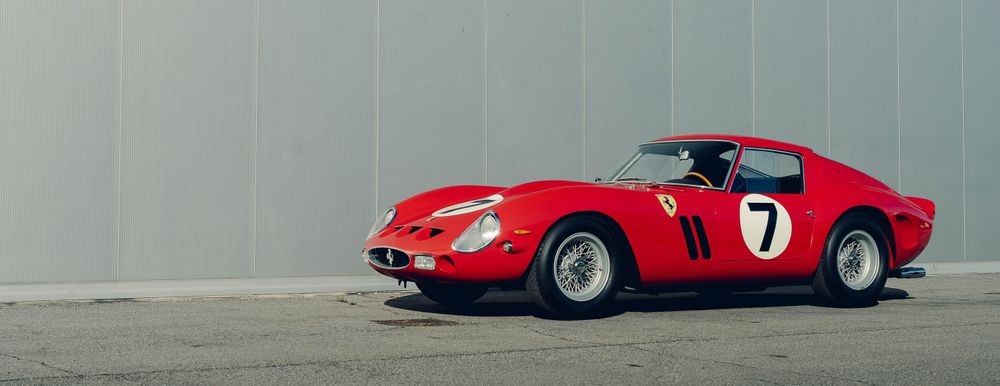
The 250 GTO, the definitive front-engined V12 gran turismo, continued to win through to 1964, completing a nine-year run of success unmatched in Tour de France history
By the time the remaining entrants reached the final circuit test at Montlhéry, the field had been decimated from 103 to just 37 participants. De Portago needed only to maintain his margin over Moss to secure victory, and he did just that.
It had not been plain sailing – the 250 GT’s battle-scarred front wing and crumpled headlamp surround told their own story – but when the pair arrived in Paris ahead of Moss in second and Gendebien’s Ferrari 250 Europa GT in third, it marked the start of a new era of Ferrari dominance. Tragically, it would be de Portago’s final Tour de France victory. The following May, he would be killed in the Mille Miglia, along with Nelson and nine spectators, in an accident so severe it would ultimately lead to the demise of the race itself.
However, Ferrari’s success with the 250 GT Berlinetta continued to build on the young aristocrat’s legacy with consecutive Tour de France victories through to 1959, before the short-wheelbase 250 GT and subsequent 250 GTO extended the winning streak through to 1964.
But it all began with chassis 0557 GT, Alfonso de Portago and Ed Nelson back in ’56.
